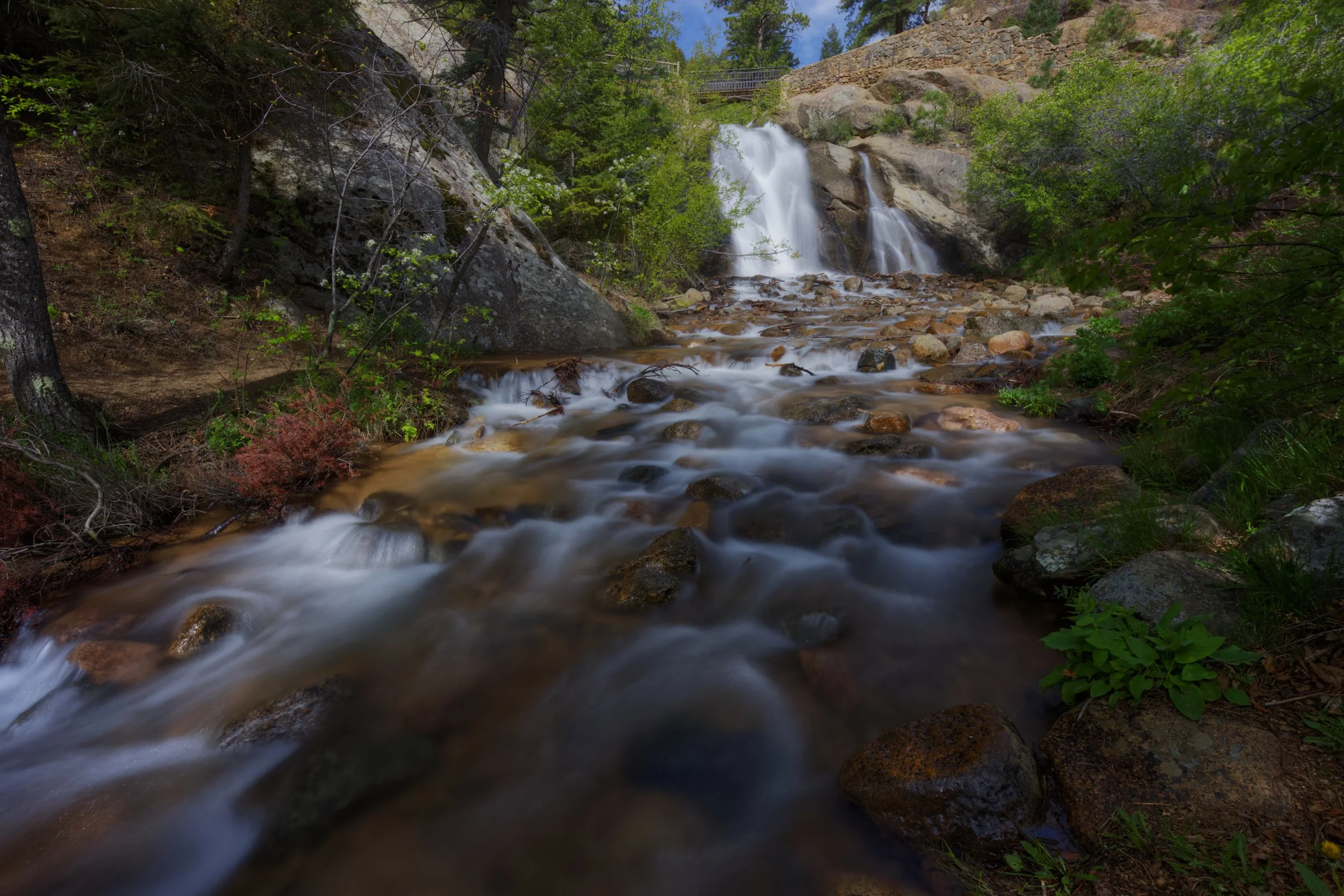
Springtime in a Colorado Canyon

from $34.00

Late spring in North Cheyenne Canyon. After a long, muted winter, the recent rains had acted as a catalyst, transforming the landscape into an almost neon shade of vibrant green. Every fern, moss-covered stone, and budding branch seemed to be surging with new life, reaching out to drink in the heavy, humid air.

While most people view the iconic Helen Hunt Falls from the bridge or the designated overlook, I knew that the "postcard" angle wouldn’t capture the energy I was feeling. I wanted the pulse of the water, not just the view of it. I began a slow, deliberate scramble down the embankment, picking my way over slick stones and tangled roots to reach the edge of the creek.

It’s in these moments - feet braced against the bank, tripod leveled on uneven ground - that the importance of perspective becomes clear. In landscape photography, your first instinct is often your most common one. To find something unique, you have to move. You have to look where others don't, shifting your eye level to find a frame that feels like a discovery rather than a repetition.

Down in the belly of the creek, the world changed. The rushing water of the falls became a roar, a powerful focal point that anchored the entire scene. Yet, despite the power of the water, there was a profound sense of peace. I was completely alone, tucked away from the trail. Between the rhythmic thrum of the falls, I could hear the sharp, clear chirping of birds returning for the season and the soft, rhythmic creak of branches swaying in the canyon breeze.

I waited there, engulfed in that symphony of water and wind, until the clouds above made the light hit just right. This shot isn't just about a waterfall; it’s about that fleeting, vibrant window where the canyon wakes up and reminds you that the best views are earned by those willing to change their point of view.

Late spring in North Cheyenne Canyon. After a long, muted winter, the recent rains had acted as a catalyst, transforming the landscape into an almost neon shade of vibrant green. Every fern, moss-covered stone, and budding branch seemed to be surging with new life, reaching out to drink in the heavy, humid air.

While most people view the iconic Helen Hunt Falls from the bridge or the designated overlook, I knew that the "postcard" angle wouldn’t capture the energy I was feeling. I wanted the pulse of the water, not just the view of it. I began a slow, deliberate scramble down the embankment, picking my way over slick stones and tangled roots to reach the edge of the creek.

It’s in these moments - feet braced against the bank, tripod leveled on uneven ground - that the importance of perspective becomes clear. In landscape photography, your first instinct is often your most common one. To find something unique, you have to move. You have to look where others don't, shifting your eye level to find a frame that feels like a discovery rather than a repetition.

Down in the belly of the creek, the world changed. The rushing water of the falls became a roar, a powerful focal point that anchored the entire scene. Yet, despite the power of the water, there was a profound sense of peace. I was completely alone, tucked away from the trail. Between the rhythmic thrum of the falls, I could hear the sharp, clear chirping of birds returning for the season and the soft, rhythmic creak of branches swaying in the canyon breeze.

I waited there, engulfed in that symphony of water and wind, until the clouds above made the light hit just right. This shot isn't just about a waterfall; it’s about that fleeting, vibrant window where the canyon wakes up and reminds you that the best views are earned by those willing to change their point of view.

Material:
Size:

Metal Prints

Metal prints are celebrated for their unmatched durability and vibrant color presentation, delivering extraordinary sharpness and detail. The sleek, modern finish enhances the luminosity of each image, making colors pop with a radiant glow. With superior fade resistance, metal prints maintain their brilliance over time, embodying the pinnacle of photographic reproduction.

Each image is first printed to a transfer paper, then infused into Chromaluxe metal by heat and pressure. This process combined with our custom made color profiles give true to life colors and exceptional detail.

Fine Art Glicee Paper Prints

Fine art prints stand out with their exceptional quality, capturing the subtlety of shades and the intricacies of texture, ideal for reproducing artworks and photographs with artistic merit. Their archival inks and heavyweight papers promise longevity and aesthetic appeal, offering a sophisticated, gallery-worthy presentation that honors the creator's vision. All fine art prints require framing. I currently do not offer framing or mat boards for photo prints and fine art prints.

My fine art prints utilize the highest quality archival inks printed onto premium photo paper. This process ensures a sharp and true-to-life image, reflecting both the subtleties and vibrance of the original.

Canvas Prints

A museum-quality canvas ready for display. Using the giclee printing process, archival ink is sprayed onto these fine art canvases and gallery-wrapped. These prints feature subtle fine art texture with ultra-tight corners and sharp color accuracy.

All photos are printed on certified archival quality canvas that is hand-stretched in the USA around a 1.5” wood stretcher frame. Canvas includes a smooth matte finish that eliminates any unwanted glare or reflections. Canvas is a poly-cotton blend that is guaranteed to have a 100+ year display life. With no optical brighterners or synthetic fibers, this is considered the highest quality canvas available in the photo printing industry. Once wrapped, a durable display handware is attached directly to the back of the canvas. Depending on the size, this will either be a sawtooth or wire for hanging.

Recommend using a microfiber towel to remove dust or fingerprints.