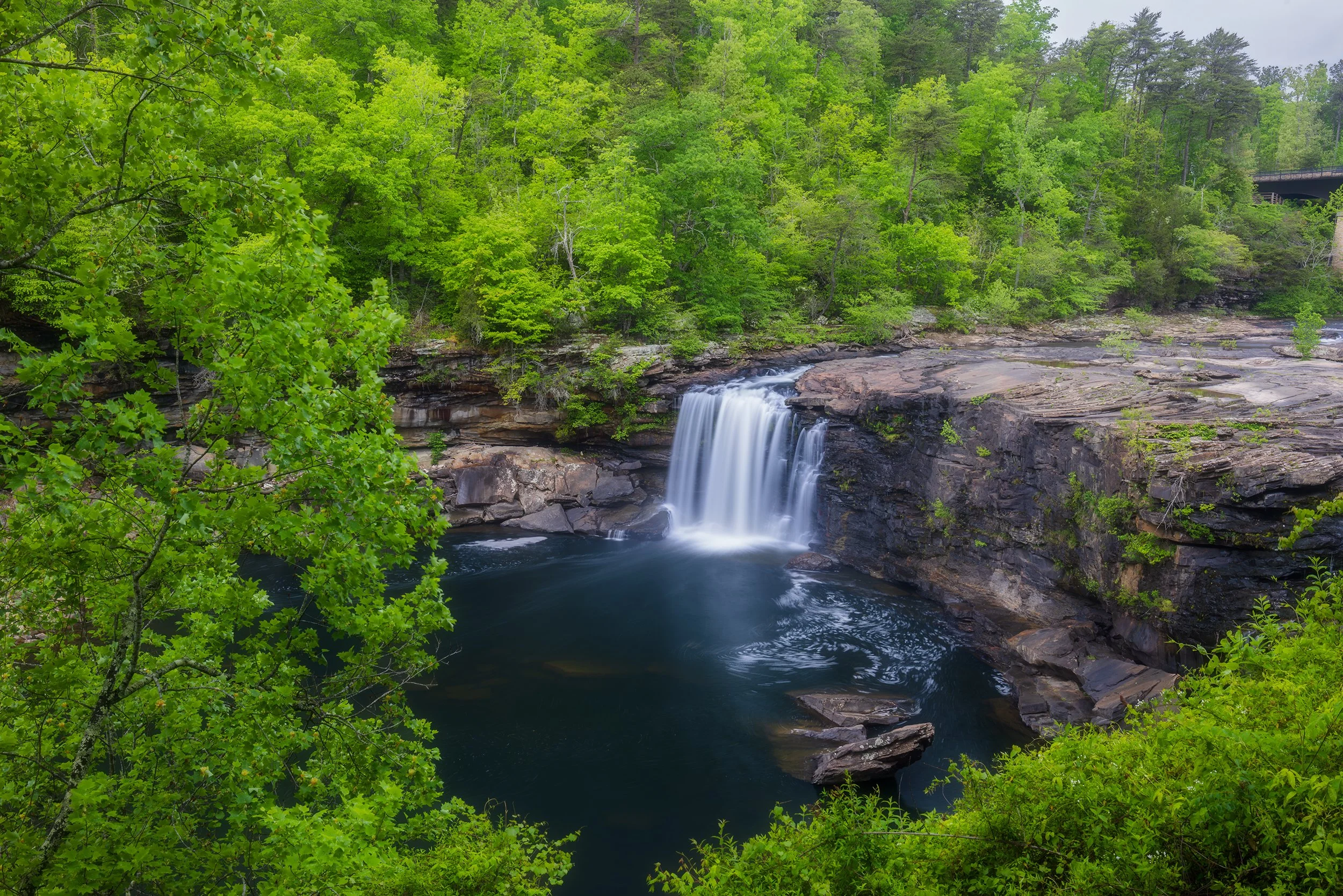
Rainy Day at the Falls

from $34.00

The rain was steady and relentless, drumming a consistent rhythm against the jacket stretched tight over my shoulders. I was back at Little River Canyon, standing before Little River Falls on a day when the water was moving with absolute majesty. The volume was perfect, a heavy, white curtain of power dropping over the ledge and sending a fine mist up to mix with the falling rain.

Yet, as I looked through the viewfinder, something felt entirely different. It had been years since my last visit to this specific overlook, and in that time, the park had completely transformed the landscape.

I looked around for the old, wild access paths I used to know so well. They were gone. The rugged tracks that once allowed me to scramble out onto the exposed, slippery river rocks right next to the roaring crest of the falls were entirely blocked off. In their place stood a heavily structured, pristine wooden boardwalk, keeping everyone at a safe, predictable distance.

Standing on the damp wood, a complicated wave of emotion hit me. I understood the change completely, and on a practical level, I appreciated it. It was a necessary evolution for public safety, designed to protect the thousands of visitors who come here each year.

But as a photographer who seeks out the raw, unfiltered edge of nature, I couldn't shake a deep sense of sadness. It was a poignant, quiet reminder that the wild margins of our parks are continuously shrinking. The spaces where you can truly feel the unmediated power of the wilderness are being tamed, one boardwalk at a time. I pressed the shutter to capture the beauty that remained, documenting a view of the falls that, while still spectacular, felt just a little more distant than before.

The rain was steady and relentless, drumming a consistent rhythm against the jacket stretched tight over my shoulders. I was back at Little River Canyon, standing before Little River Falls on a day when the water was moving with absolute majesty. The volume was perfect, a heavy, white curtain of power dropping over the ledge and sending a fine mist up to mix with the falling rain.

Yet, as I looked through the viewfinder, something felt entirely different. It had been years since my last visit to this specific overlook, and in that time, the park had completely transformed the landscape.

I looked around for the old, wild access paths I used to know so well. They were gone. The rugged tracks that once allowed me to scramble out onto the exposed, slippery river rocks right next to the roaring crest of the falls were entirely blocked off. In their place stood a heavily structured, pristine wooden boardwalk, keeping everyone at a safe, predictable distance.

Standing on the damp wood, a complicated wave of emotion hit me. I understood the change completely, and on a practical level, I appreciated it. It was a necessary evolution for public safety, designed to protect the thousands of visitors who come here each year.

But as a photographer who seeks out the raw, unfiltered edge of nature, I couldn't shake a deep sense of sadness. It was a poignant, quiet reminder that the wild margins of our parks are continuously shrinking. The spaces where you can truly feel the unmediated power of the wilderness are being tamed, one boardwalk at a time. I pressed the shutter to capture the beauty that remained, documenting a view of the falls that, while still spectacular, felt just a little more distant than before.

Material:
Size:

Metal Prints

Metal prints are celebrated for their unmatched durability and vibrant color presentation, delivering extraordinary sharpness and detail. The sleek, modern finish enhances the luminosity of each image, making colors pop with a radiant glow. With superior fade resistance, metal prints maintain their brilliance over time, embodying the pinnacle of photographic reproduction.

Each image is first printed to a transfer paper, then infused into Chromaluxe metal by heat and pressure. This process combined with our custom made color profiles give true to life colors and exceptional detail.

Fine Art Glicee Paper Prints

Fine art prints stand out with their exceptional quality, capturing the subtlety of shades and the intricacies of texture, ideal for reproducing artworks and photographs with artistic merit. Their archival inks and heavyweight papers promise longevity and aesthetic appeal, offering a sophisticated, gallery-worthy presentation that honors the creator's vision. All fine art prints require framing. I currently do not offer framing or mat boards for photo prints and fine art prints.

My fine art prints utilize the highest quality archival inks printed onto premium photo paper. This process ensures a sharp and true-to-life image, reflecting both the subtleties and vibrance of the original.

Canvas Prints

A museum-quality canvas ready for display. Using the giclee printing process, archival ink is sprayed onto these fine art canvases and gallery-wrapped. These prints feature subtle fine art texture with ultra-tight corners and sharp color accuracy.

All photos are printed on certified archival quality canvas that is hand-stretched in the USA around a 1.5” wood stretcher frame. Canvas includes a smooth matte finish that eliminates any unwanted glare or reflections. Canvas is a poly-cotton blend that is guaranteed to have a 100+ year display life. With no optical brighterners or synthetic fibers, this is considered the highest quality canvas available in the photo printing industry. Once wrapped, a durable display handware is attached directly to the back of the canvas. Depending on the size, this will either be a sawtooth or wire for hanging.

Recommend using a microfiber towel to remove dust or fingerprints.