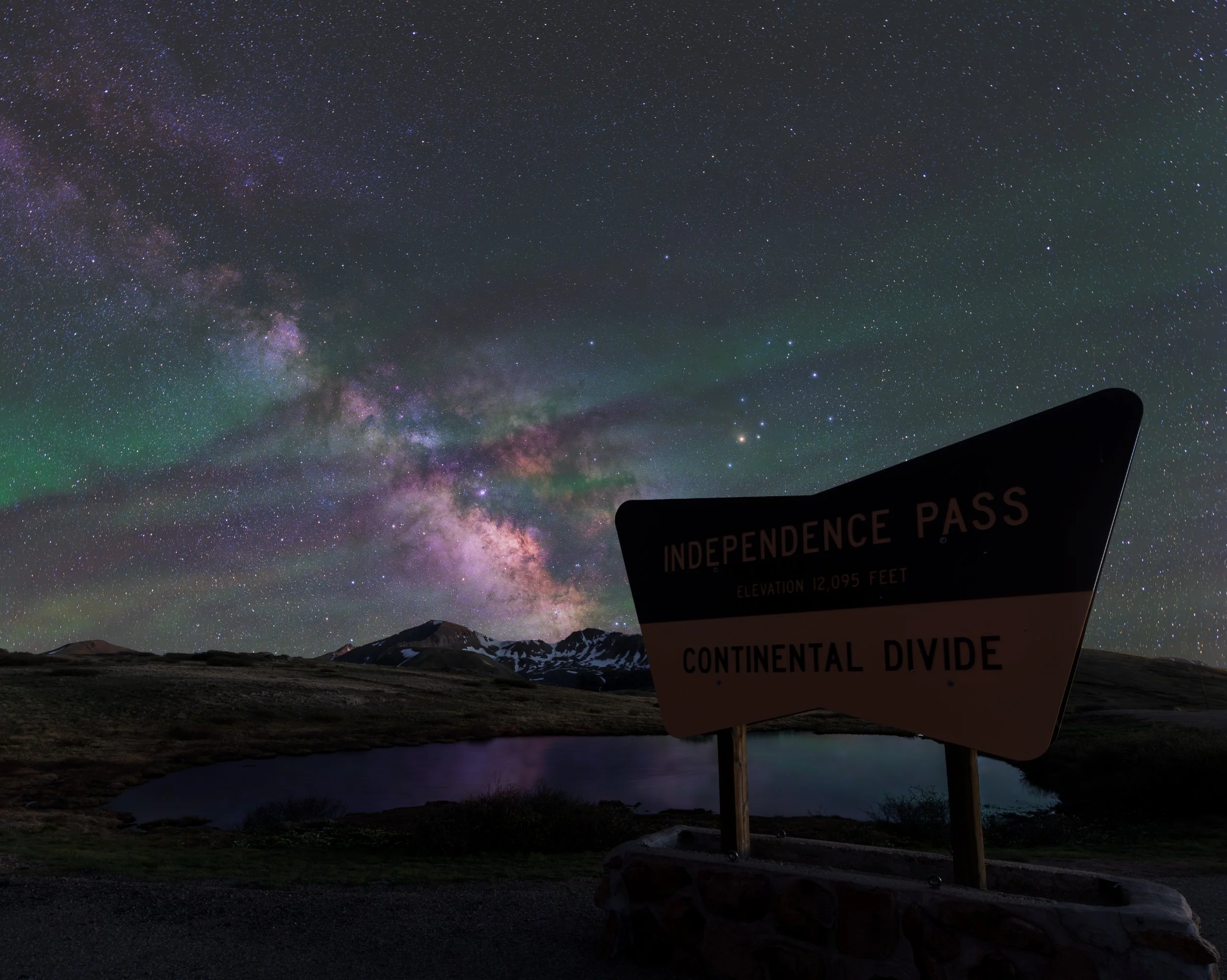
Midnight on the Divide

from $34.00

The cold at twelve thousand feet cuts right through you once the sun drops, but the real work was just beginning. Standing on the edge of the continental divide, the mountains around me were slipping into total darkness, and the sky was trading its twilight blues for the deep ink of night.

To bring home a clean, professional-grade astro-landscape image, you can't just point and shoot. Pushing the ISO too high introduces a swarm of digital noise that completely destroys the crisp textures of the mountains. My strategy was to capture the foreground first during the blue hour, using a low ISO and a long shutter speed to lock in a sharp, low-noise foundation while a tiny amount of ambient light still hugged the peaks.

The real challenge came when it was time to shoot the sky. A massive mountain peak blocked my view of the north, completely cutting off my line of sight to Polaris. Luckily, modern smart trackers don't require an unobstructed view of the North Star for a perfect polar alignment. I bypassed the northern horizon entirely, used the tracker's "go-to" feature, and targeted Antares, the fiery red supergiant burning brightly 550 light-years away in the southern sky.

After making a few micro-adjustments to the motorized axes, the unit calibrated its position against the rotation of the Earth. I switched the lens to manual focus, magnified a bright star on the live-view screen until it was a perfectly sharp, pinpoint pixel, and locked down the focus ring.

I dialed in the settings for a two-minute exposure and waited. The shutter clicked open, and the tracking head began its imperceptible, ultra-precise rotation, moving just enough to perfectly counteract the spin of the globe.

When the shutter finally snapped shut, I leaned over to look at the rear LCD screen, and my jaw dropped.

The Milky Way was spectacularly prominent, its dark dust lanes cutting through the dense stellar fog of the galactic core with incredible clarity. But the true masterpiece of the frame was something I hadn't anticipated. A massive display of atmospheric airglow, a natural phenomenon that looks like ripples of colored light painted across the night sky, was glowing vividly on the screen. It was a powerful reminder that out here, the night is never truly dark.

Midnight on the Divide is a stellar addition for anyone curating a collection focused on the cosmos, nighttime wilderness, or Colorado astrophotography. Because this image masterfully pairs the deep, silent weight of the shadowed Rocky Mountains with the vibrant, colorful energy of the galactic core and rare atmospheric airglow, it serves as a commanding centerpiece for a modern room, inviting anyone who steps in to get lost in the sheer scale of the night sky.

The cold at twelve thousand feet cuts right through you once the sun drops, but the real work was just beginning. Standing on the edge of the continental divide, the mountains around me were slipping into total darkness, and the sky was trading its twilight blues for the deep ink of night.

To bring home a clean, professional-grade astro-landscape image, you can't just point and shoot. Pushing the ISO too high introduces a swarm of digital noise that completely destroys the crisp textures of the mountains. My strategy was to capture the foreground first during the blue hour, using a low ISO and a long shutter speed to lock in a sharp, low-noise foundation while a tiny amount of ambient light still hugged the peaks.

The real challenge came when it was time to shoot the sky. A massive mountain peak blocked my view of the north, completely cutting off my line of sight to Polaris. Luckily, modern smart trackers don't require an unobstructed view of the North Star for a perfect polar alignment. I bypassed the northern horizon entirely, used the tracker's "go-to" feature, and targeted Antares, the fiery red supergiant burning brightly 550 light-years away in the southern sky.

After making a few micro-adjustments to the motorized axes, the unit calibrated its position against the rotation of the Earth. I switched the lens to manual focus, magnified a bright star on the live-view screen until it was a perfectly sharp, pinpoint pixel, and locked down the focus ring.

I dialed in the settings for a two-minute exposure and waited. The shutter clicked open, and the tracking head began its imperceptible, ultra-precise rotation, moving just enough to perfectly counteract the spin of the globe.

When the shutter finally snapped shut, I leaned over to look at the rear LCD screen, and my jaw dropped.

The Milky Way was spectacularly prominent, its dark dust lanes cutting through the dense stellar fog of the galactic core with incredible clarity. But the true masterpiece of the frame was something I hadn't anticipated. A massive display of atmospheric airglow, a natural phenomenon that looks like ripples of colored light painted across the night sky, was glowing vividly on the screen. It was a powerful reminder that out here, the night is never truly dark.

Midnight on the Divide is a stellar addition for anyone curating a collection focused on the cosmos, nighttime wilderness, or Colorado astrophotography. Because this image masterfully pairs the deep, silent weight of the shadowed Rocky Mountains with the vibrant, colorful energy of the galactic core and rare atmospheric airglow, it serves as a commanding centerpiece for a modern room, inviting anyone who steps in to get lost in the sheer scale of the night sky.

Material:
Size:

Metal Prints

Metal prints are celebrated for their unmatched durability and vibrant color presentation, delivering extraordinary sharpness and detail. The sleek, modern finish enhances the luminosity of each image, making colors pop with a radiant glow. With superior fade resistance, metal prints maintain their brilliance over time, embodying the pinnacle of photographic reproduction.

Each image is first printed to a transfer paper, then infused into Chromaluxe metal by heat and pressure. This process combined with our custom made color profiles give true to life colors and exceptional detail.

Fine Art Glicee Paper Prints

Fine art prints stand out with their exceptional quality, capturing the subtlety of shades and the intricacies of texture, ideal for reproducing artworks and photographs with artistic merit. Their archival inks and heavyweight papers promise longevity and aesthetic appeal, offering a sophisticated, gallery-worthy presentation that honors the creator's vision. All fine art prints require framing. I currently do not offer framing or mat boards for photo prints and fine art prints.

My fine art prints utilize the highest quality archival inks printed onto premium photo paper. This process ensures a sharp and true-to-life image, reflecting both the subtleties and vibrance of the original.

Canvas Prints

A museum-quality canvas ready for display. Using the giclee printing process, archival ink is sprayed onto these fine art canvases and gallery-wrapped. These prints feature subtle fine art texture with ultra-tight corners and sharp color accuracy.

All photos are printed on certified archival quality canvas that is hand-stretched in the USA around a 1.5” wood stretcher frame. Canvas includes a smooth matte finish that eliminates any unwanted glare or reflections. Canvas is a poly-cotton blend that is guaranteed to have a 100+ year display life. With no optical brighterners or synthetic fibers, this is considered the highest quality canvas available in the photo printing industry. Once wrapped, a durable display handware is attached directly to the back of the canvas. Depending on the size, this will either be a sawtooth or wire for hanging.

Recommend using a microfiber towel to remove dust or fingerprints.