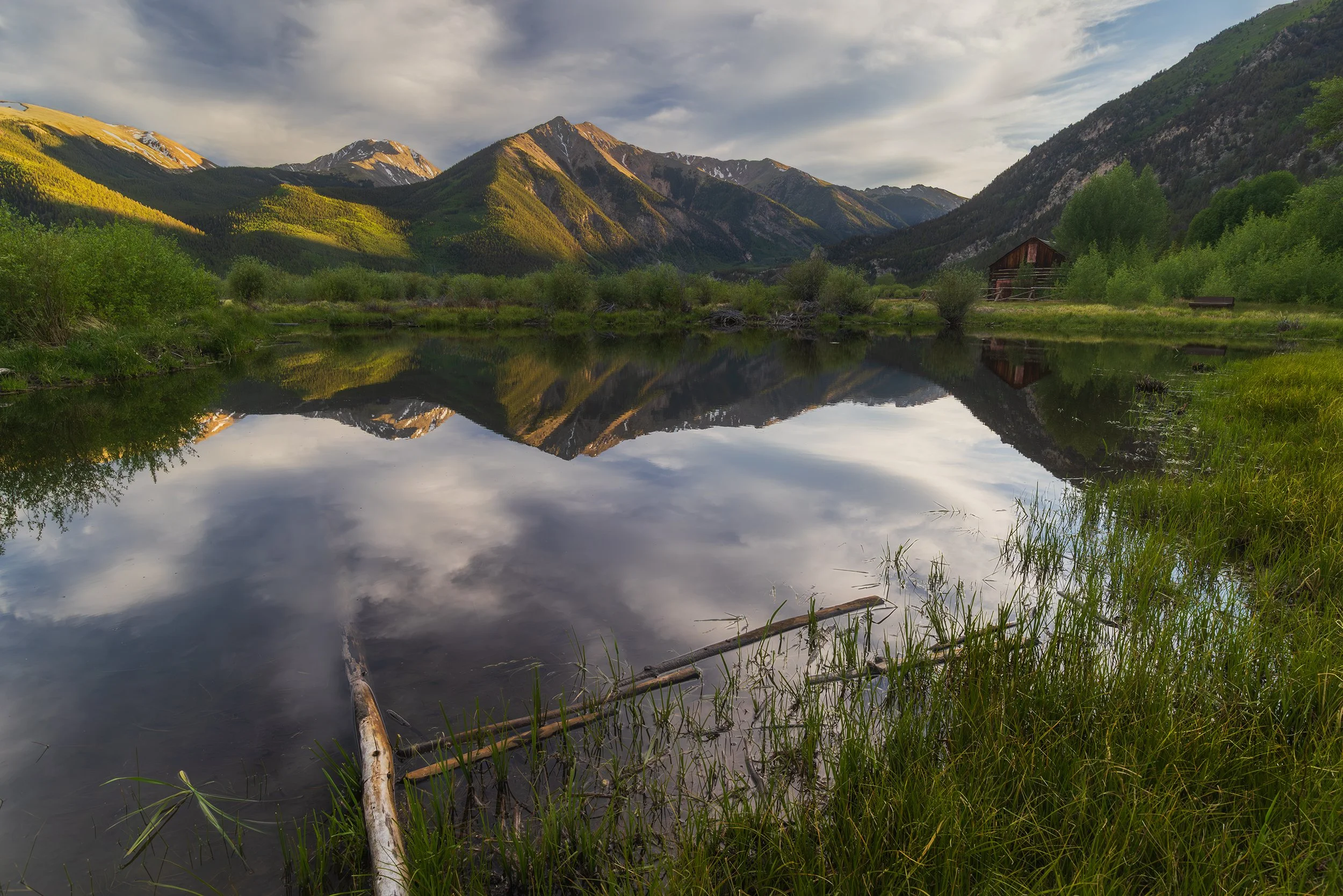
An Evening at Twin Lakes

from $34.00

I rolled into Twin Lakes around 7:45 in the evening, and every ounce of lingering road frustration dissolved the moment the engine cut out.

Nestled right at the foot of Independence Pass, this quiet settlement feels like a living remnant of the late 1800s. It was originally established as a way station for miners traveling between Leadville and Aspen, and today it boasts a year-round population that barely clears double digits. The tiny town sits under the literal shadow of Mount Elbert, the highest peak in Colorado and the entire Rocky Mountain chain, which rises to a staggering 14,440 feet. Because of its massive eastern bulk, the mountain casts the historic area into a deep, cool twilight long before the sun actually sets below the western horizon.

Near the edge of the lakes stands a weathered, historic log barn flanked by a small, still pond. The jagged, snow-dusted peaks of the Rockies rise directly behind it like a wall of granite and ice. I pulled off the shoulder, grabbed my camera body and lens, and walked down a faint game trail through the high grass toward the water's edge.

To my amazement, the pond was a flawless mirror because the wind had died down completely. As I leveled my tripod, the sensory detail of the Colorado mountain landscape washed over me. Birds were singing their final evening notes, darting overhead, and a light, cool breeze occasionally rustled the long alpine grasses. In the distance, the faint, warm sound of laughter and clinking glasses drifted over from the historic village.

Then, the magic happened. The very last rays of daylight struck the high ridges of the continental divide, painting the stone in a rich, copper glow that reflected perfectly in the motionless water below. I pressed the shutter, capturing a moment where Colorado's mining history and its grandest geography met in absolute stillness.

I rolled into Twin Lakes around 7:45 in the evening, and every ounce of lingering road frustration dissolved the moment the engine cut out.

Nestled right at the foot of Independence Pass, this quiet settlement feels like a living remnant of the late 1800s. It was originally established as a way station for miners traveling between Leadville and Aspen, and today it boasts a year-round population that barely clears double digits. The tiny town sits under the literal shadow of Mount Elbert, the highest peak in Colorado and the entire Rocky Mountain chain, which rises to a staggering 14,440 feet. Because of its massive eastern bulk, the mountain casts the historic area into a deep, cool twilight long before the sun actually sets below the western horizon.

Near the edge of the lakes stands a weathered, historic log barn flanked by a small, still pond. The jagged, snow-dusted peaks of the Rockies rise directly behind it like a wall of granite and ice. I pulled off the shoulder, grabbed my camera body and lens, and walked down a faint game trail through the high grass toward the water's edge.

To my amazement, the pond was a flawless mirror because the wind had died down completely. As I leveled my tripod, the sensory detail of the Colorado mountain landscape washed over me. Birds were singing their final evening notes, darting overhead, and a light, cool breeze occasionally rustled the long alpine grasses. In the distance, the faint, warm sound of laughter and clinking glasses drifted over from the historic village.

Then, the magic happened. The very last rays of daylight struck the high ridges of the continental divide, painting the stone in a rich, copper glow that reflected perfectly in the motionless water below. I pressed the shutter, capturing a moment where Colorado's mining history and its grandest geography met in absolute stillness.

Material:
Size:

Metal Prints

Metal prints are celebrated for their unmatched durability and vibrant color presentation, delivering extraordinary sharpness and detail. The sleek, modern finish enhances the luminosity of each image, making colors pop with a radiant glow. With superior fade resistance, metal prints maintain their brilliance over time, embodying the pinnacle of photographic reproduction.

Each image is first printed to a transfer paper, then infused into Chromaluxe metal by heat and pressure. This process combined with our custom made color profiles give true to life colors and exceptional detail.

Fine Art Glicee Paper Prints

Fine art prints stand out with their exceptional quality, capturing the subtlety of shades and the intricacies of texture, ideal for reproducing artworks and photographs with artistic merit. Their archival inks and heavyweight papers promise longevity and aesthetic appeal, offering a sophisticated, gallery-worthy presentation that honors the creator's vision. All fine art prints require framing. I currently do not offer framing or mat boards for photo prints and fine art prints.

My fine art prints utilize the highest quality archival inks printed onto premium photo paper. This process ensures a sharp and true-to-life image, reflecting both the subtleties and vibrance of the original.

Canvas Prints

A museum-quality canvas ready for display. Using the giclee printing process, archival ink is sprayed onto these fine art canvases and gallery-wrapped. These prints feature subtle fine art texture with ultra-tight corners and sharp color accuracy.

All photos are printed on certified archival quality canvas that is hand-stretched in the USA around a 1.5” wood stretcher frame. Canvas includes a smooth matte finish that eliminates any unwanted glare or reflections. Canvas is a poly-cotton blend that is guaranteed to have a 100+ year display life. With no optical brighterners or synthetic fibers, this is considered the highest quality canvas available in the photo printing industry. Once wrapped, a durable display handware is attached directly to the back of the canvas. Depending on the size, this will either be a sawtooth or wire for hanging.

Recommend using a microfiber towel to remove dust or fingerprints.